
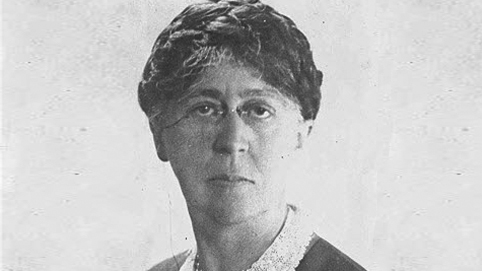
Mary Parker Follett and democratic visions of leadership
There are three ways of dealing with difference: domination, compromise, and integration. By domination only one side gets what it wants; by compromise neither side gets what it wants; by integration we find a way by which both sides may get what they wish.
Mary Parker Follett
My academic research field focuses on leadership and organizational theory, and – being the nerd that I am – I was reading through a new(ish) textbook on org theory the other day, one by Mary Jo Hatch (titled simply Organization Theory – Amazon).
She brought back to my mind the incredible contributions of Mary Parker Follett, a Quaker social worker and organizational theorist of the early 1900s, well ahead of her time.
This short overview of her key ideas is easy to read and very valuable:
https://www.michelezanini.com/mary-parker-follett-the-first-prophet-of-management/
Power-with, not power-over
Follett has a ton to say about the value of self-organizing teams and the value of democratizing the workplace. Hierarchy does not need to rule if everyone is committed (via positive working relationships and trust) to a greater goal. As she wrote, we take orders from the situation, not from each other, when we are operating in a healthy team. (My statement of her concept.)
But what really has me “chewing” today is the way Follett suggests a third path for wielding power: Not power-over (domination) or unsatisfying compromise, but power-with (“integration”). In other words, power can be engaged among a group of people as a creative force to tackle and solve a problem (this reminds me a bit of Adaptive Leadership Theory, much written about by Ron Heifetz).
Think of how much this turns power structures sideways! Follett is not saying “no one should be in charge”; she ran multiple community centers across Boston that served thousands.
Instead, Follett noticed that both dominating power and compromising power leave dissatisfying gaps in outcomes.
Domination works against trust and relationships, imposing one’s needs on the other. Even in a “benevolent dictatorship” (such as a very teacher-driven classroom), such use of power strips the subordinates of much of their agency and trains people to either become passive and helpless, simply flowing with the demands of the power-holder, or rebels, seeking to take power by any means necessary. Either response reflects the disordered nature of this power structure. Very few situations call for dominant power: military command structures (though this needs further interrogation), emergency response situations, burning buildings, disasters, etc. You get my point.
Meanwhile, the often-applauded skill of brokering compromise is likewise somewhat a failure of power in Follett’s view. In a compromise, both parties give up something they want to gain a more-or-less palatable “middle ground.” It’s better than domination, but now both parties may end up dissatisfied: neither side may be happy with the results.
Compromise and negotiation keep things running, but they also train people to see everything as an asset to broker. As a former teacher, I saw this in some of my negotiations with students when I was attempting to move to a more student-centric classroom structure. For example, haggling over a project’s due date never bothered me, but at some point, I had teacher-goals which were inherently incompatible with some students’ desires, and the easiest path to reconciliation was often to provide the illusion of choice in the form of a compromise that didn’t really demand anything of me. I can flex a deadline all day as long as my grades are in by the end of a semester.
I think 21st century American politics bears out these two paths of power as the most common as well as not necessarily successful: we are so dysfunctional as a society with zero trust in the other political party that domination is the primary goal of the party in power (particularly in Congress), with compromise as the “sensible” option where everyone hates part of a bill so they can all vote for it anyway. “See? We had to give up this very important point as a concession! Let’s not lose progress on that goal.” And that’s fine; I’d argue compromise is better than domination.
follet’s third way: integration
Where Follett shines, to me, is in her third way: Power-with — power as a creative force enabling people who want a common (good) outcome to integrate everything they actually want into a framework that satisfies the vast majority of those goals along the way to gaining the larger, important objective.
If everyone is trying to solve the same problem and committed to the good of the group as well as their own individual needs — i.e., if everyone involved is actually capable of empathy — then integration of needs through the power of creative problem-solving can yield incredible results, at least in a group small enough for everyone to share the same overarching goals.
That unified goal is critical; I’d argue that without it, Follett’s third way of power collapses into one of the other two. I’d also argue that, while America has often struggled to articulate a unified civic vision for what our nation should do in reflection of our shared values, those shared values are under particular attack at the moment. I think we are at an inflection point as a people, and the decisions we make (at the ballot box and through our framing of public discourse) will deeply shape the next 75 years.
Follett’s view of power aligns with her view of leadership and authority. The problem being faced is what constrains the actions of the group and its leader(s). She does not seem to ignore the impact of people and their motives on group leadership; if anything, I think Follett’s viewpoint empowers far more individuals than “those in charge” and endows them with the responsibility to speak out, and for leaders to ignore followers at their peril.
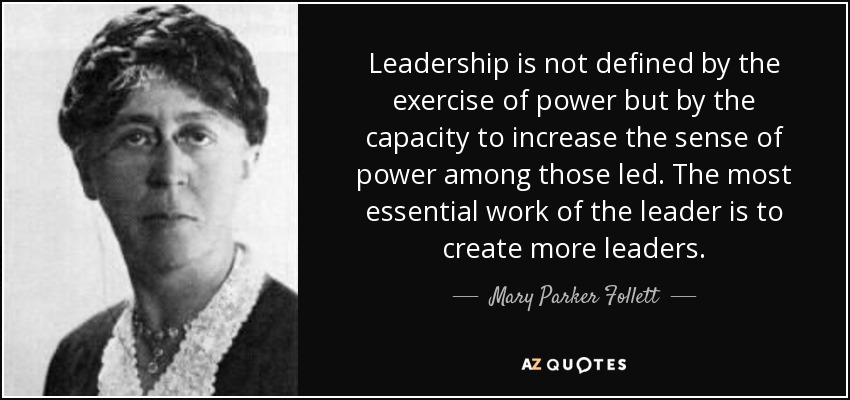
I particularly like this quote as an example of Follett’s democratizing views of leadership:
In this way, I find communion between Follett in org theory and Freire in critical pedagogy, with Freire’s realization that education must be a democratizing event for both the teacher and the student or it dehumanizes both. American schools continue to resist that lesson, but that’s a post for another day …
It’s not lost on me that one of the only women working in org theory in the 20th century also eschewed the value of domination, seeking instead a holistic and collaborative, in fact “democratic” approach to leadership and authority. We desperately need greater representation of women in board rooms and CEO positions to bring fresh perspectives into corporate governance — unfortunately, women have lost ground since the pandemic on C-suite representation, reversing a positive trend of 20 years.
I keep chewing:
Follett’s insight here raises some questions in my mind:
- Is power-with possible apart from a culture of trust? My hunch is no, but I think savvy power-brokers find ways to integrate competing demands into a holistic win for everyone. Sometimes we see this in politics, and it used to be much more common in Congress in my living memory (the ‘80s and ‘90s). People present demands, but their words cloak a deeper, greater objective. Of course, power-with assumes we have a shared overarching positive goal or a problem we all want to solve. I’m not convinced the current [2024] Republican part wants American democracy to thrive when fascism would make the oligarchs so much happier, and Democrats are very beholden to the same wealth/power class of ultra-rich donors. We live in a very low-trust society right now, but I don’t think that precludes the possibility of “power-with” types of agreements to address core issues in American politics which both sides agree need to be solved. The question remains: How much disagreement can exist before power-with is a closed path for us nationally?
- Is power-with actually a form of “true” power? I’m not an expert on the philosophical concept of “power”; I know enough to know that we have to define terms to answer this question. I can’t fit a long discussion into this short point, so I’m going to raise the question and let it simmer for myself and anyone who wants to join me. Does the dominating nature of “power” simply recede when this integral approach to power is being successful? Does domination lurk in the background as a last-resort? Is it an inevitable element of human nature to seek dominating power, relegating compromise or creative uses to power to situations where the one(s) holding the greater level of power assent to less obvious dominance as long as they are still getting what they want?
For me, I plan to marinate on this concept of creative power of integration and look for examples (historic, fictional) of it working and failing. I recently read “I just kept smiling,” a short story by Simon Burt that makes its way into a lot of middle school literature textbooks, and I find the main character’s actions provide an interesting commentary on how individuals on the bottom of a power system find ways to control whatever they can.
Feel free to drop ideas in the comments if any come to mind.
Every word written by me! I’m not on a crusade against AI, but I’m out here doing my part to push back on the Dead Internet.

 just:words
Leave a reply to The Mindful Migraine Blog Cancel reply